
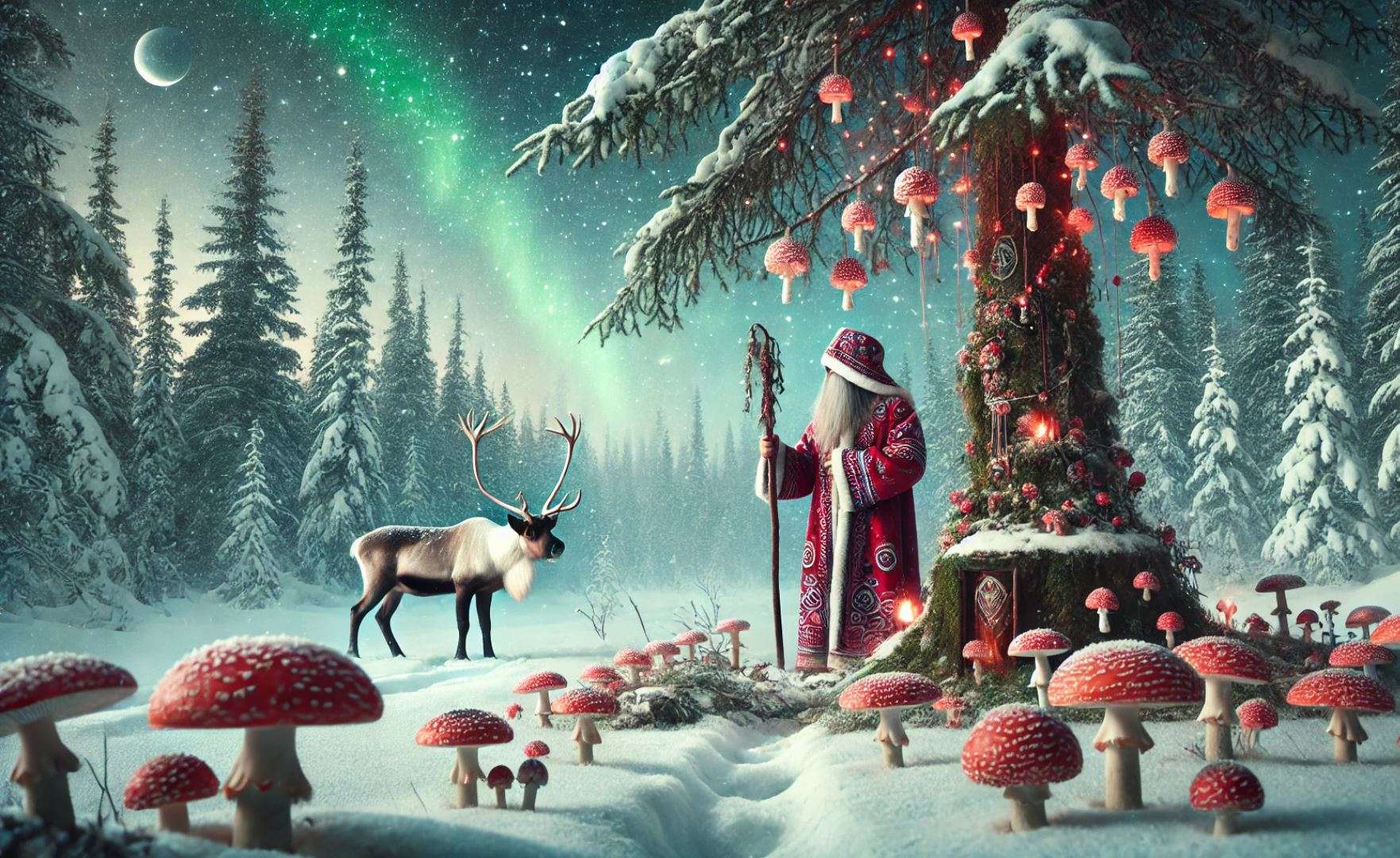
Could This Be the Real True Story of Santa Claus?
The story of Santa Claus may not be as straightforward as we think. Beneath the layers of modern Christmas traditions lies a fascinating link to the shamanic practices of Siberia and their relationship with the red-and-white fly agaric mushroom (Amanita muscaria). These practices not only influenced ideas of flying reindeer and presents under the tree but also echoed through other cultures around the world.
The Red and White Connection
Siberian shamans traditionally wore ceremonial robes in striking red and white hues, mirroring the iconic colours of the fly agaric mushroom. This striking fungus, with its bright red cap speckled with white spots, was not just a visual inspiration but also central to their spiritual rituals. The shamans believed these mushrooms held a divine connection, granting them access to heavenly realms and profound visions.
Imagine the shaman, draped in their red-and-white attire, walking through the snowy Siberian forests in search of these sacred fungi. The mushrooms often grew under fir trees, an observation that perhaps laid the groundwork for the Christmas tradition of placing gifts under a decorated tree. To the shamans, the mushrooms were more than a natural phenomenon—they were gifts from the divine, bestowed beneath the evergreen boughs.
Reindeer: Sacred Guides
Reindeer were integral to the shamans’ lives, both as a means of survival and as spiritual guides. Reindeer naturally seek out fly agaric mushrooms and consume them with gusto, seemingly drawn to their psychoactive properties. Observing this behaviour, shamans used reindeer as their guides to locate the mushrooms hidden beneath snow-covered forests.
The relationship between shamans, reindeer, and the mushrooms didn’t stop there. Shamans discovered that consuming the mushrooms directly could lead to severe nausea or toxicity. Instead, they let the reindeer consume them first. The reindeer’s metabolism filtered out the more harmful compounds, leaving the psychoactive elements concentrated in the animal’s urine. Shamans would then collect and drink this urine to safely experience the mushrooms’ hallucinogenic effects.
Under the influence of these purified compounds, the shamans often described visions of flight—soaring through the skies alongside their reindeer. This imagery might have inspired the later folklore of Santa Claus flying with his magical sleigh, pulled by reindeer across a starry Christmas sky.
The Lightning God and the Son of the Earth
The fly agaric mushroom thrives in symbiosis with the roots of trees, particularly firs and birches, and appears abundantly after storms. For the shamans, lightning was seen as a divine act of fertilization, bringing the mushrooms to life. They believed these mushrooms were the “sons of God,” sent from the heavens to offer visions and wisdom. By consuming them, the shamans felt they could commune with higher realms, experiencing a heavenly journey or a glimpse of divine understanding.
This connection to the heavens also resonates with broader Christmas symbolism. Just as the mushrooms were seen as divine gifts from above, Christmas celebrates the arrival of a sacred child—a gift to humanity. The evergreen fir tree, central to both traditions, becomes a bridge between the earthly and the celestial.
Similar Practices in Other Cultures
The Siberian traditions are not unique in connecting the fly agaric mushroom to spiritual or celebratory practices. In ancient Nordic cultures, Odin, the ‘Allfather’, was believed to fly across the sky during the Yuletide season, a precursor to modern Christmas. Some scholars suggest that Odin’s legendary eight-legged steed, Sleipnir, may have inspired the idea of Santa’s eight reindeer. The association with the fly agaric mushroom’s hallucinogenic properties fits with Odin’s reputation for wisdom and his pursuit of visions.
Elsewhere, indigenous tribes in Lapland also revered the fly agaric mushroom, consuming it during winter solstice ceremonies to induce altered states of consciousness. These rituals celebrated the cycle of death and rebirth, mirroring the themes of renewal and generosity that we now associate with Christmas.
In Central Europe, the fly agaric mushroom appears in folk tales and illustrations as a symbol of good fortune, often linked to the holiday season. The mushroom’s red-and-white cap is still seen today in Christmas decorations, from tree ornaments to greeting cards, a subtle nod to its cultural significance.
The Gift Beneath the Tree
One of the most striking parallels between shamanic traditions and modern Christmas is the act of finding the mushrooms under fir trees. To the shamans, the mushrooms were sacred treasures gifted by the earth and sky, their discovery marked by deep reverence. Today, we mimic this ritual by placing presents beneath our Christmas trees, a gesture laden with echoes of ancient wisdom.
The tradition of hanging stockings by the fire may also have roots in these practices. In the harsh Siberian winters, shamans would hang the harvested mushrooms to dry, often over a fire or within their homes. Could this be the origin of our custom of hanging stockings to be filled with gifts?
A Journey Through Time
The modern figure of Santa Claus is a tapestry woven from diverse cultural threads. While the jolly man in red owes much to St. Nicholas and 19th-century American poets, the deeper, older roots of his story lie in the shamanic practices of Siberia and beyond. From the red-and-white attire to flying reindeer and gifts under the tree, the echoes of the fly agaric mushroom and the rituals it inspired are unmistakable.
This holiday season, as you gaze at your Christmas tree, take a moment to imagine a snowy Siberian forest, where shamans once sought divine gifts beneath the evergreens. Their story reminds us that Christmas is not just a celebration of material gifts but also a time to seek connection—with each other, with the earth, and with the divine.


